50 US States - American Quiz
Andrey SolovyevTrivia
4.5795.00 Reviews
- Version
- 3.6.0
- Installs
- 500.00K
- Age Rating
- Everyone
Screenshots
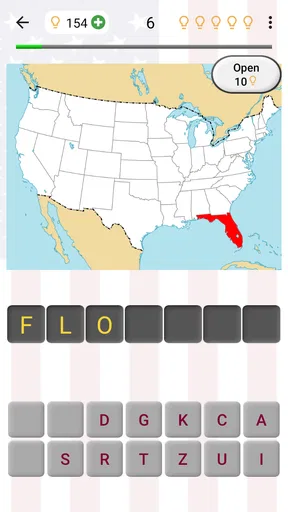
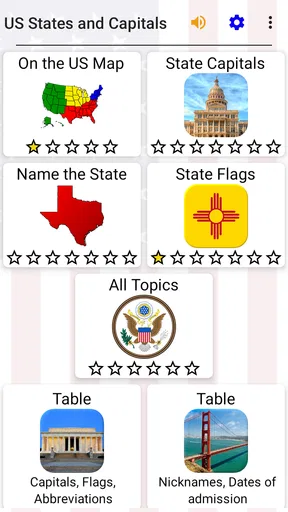
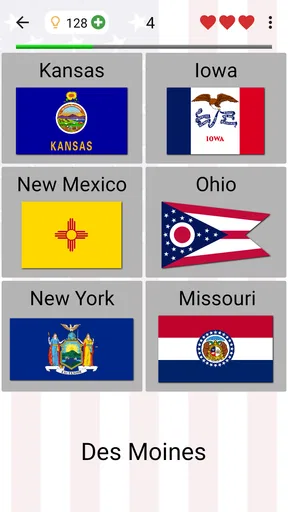
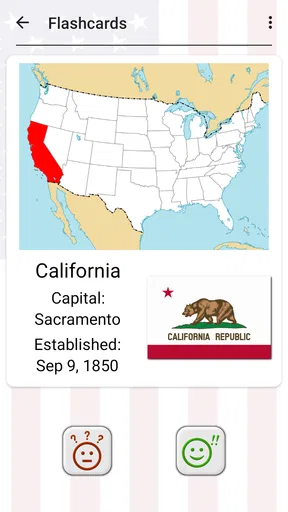
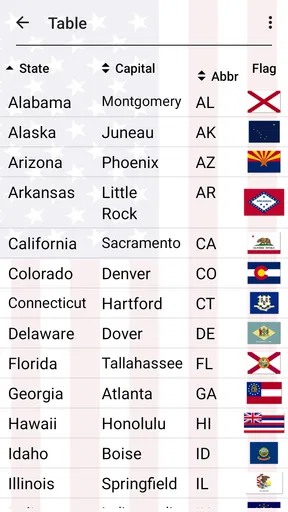
Our Review of 50 US States - American Quiz
 Analysis by Appyee
I approached 50 US States - American Quiz expecting a straightforward study game, and that is exactly where its appeal begins. It is a free trivia game from Andrey Solovyev built around recognizing all the US states, their capitals, flags, and maps. Rather than burying the subject under a complicated adventure layer, it keeps the learning target visible from the first question. I found that simplicity useful: when I had a few spare minutes, I could open it, answer a short run of questions, and immediately see which parts of American geography I actually remembered.
The game is available to an Everyone audience, runs on Android 6.0 and later, and has reached over 500 thousand installs. Its average rating is 4.5 from around 5 thousand ratings, which fits my impression of a focused educational title that does one narrow job well. It is free to start, although optional in-app purchases range from $0.99 to $5.99 per item. The current version is 3.6.0, and the game first appeared on September 2, 2014.
Learning the map through a clear visual language
The strongest part of the presentation is its subject matter rather than any decorative theme. The United States itself supplies the visual identity: state outlines, flags, capital names, and geographic placement become the vocabulary of every session. That gives the game a coherent mood without needing a fictional setting. I was always aware that I was practicing a particular kind of knowledge, not simply answering disconnected general-knowledge questions.
That focus matters because state trivia can feel abstract when studied from a list. A name such as Nebraska or Vermont is easy to recognize on paper, but recognition becomes more useful when it is tied to a shape, a flag, a capital, and a position on the map. The game’s combination of these areas encourages those connections. I found myself remembering a capital more reliably when I mentally attached it to the state’s outline or flag instead of treating it as an isolated fact.
The art direction is functional and restrained. This is not a game I would choose for elaborate animation, character design, or a dramatic visual world. Its visual language is closer to a compact atlas turned into an interactive quiz. That restraint is a strength during study because the interface does not compete with the information. It also explains the main limitation: players looking for visual spectacle may find the experience plain.
One useful way to play is to change what you look at before answering. On an early pass, I focused on the state name and tried to recall its capital. On another pass, I paid attention to the flag or map context and worked backward to the answer. This makes the same broad subject feel less repetitive and exposes different weaknesses. Someone who knows capitals but confuses neighboring states can use the map-oriented questions as a separate exercise rather than assuming their geography is already solid.
The presentation also makes the game approachable for families. A child can identify a familiar flag or state shape, while an adult can use the same session to repair gaps that have survived since school. Because the content rating is Everyone, it is easy to imagine using it as a light learning activity without the tone becoming too serious. I would still guide younger players at first, especially if they need help understanding why a wrong answer was wrong.
Why the setting works without a fictional story
There is no need for a narrative journey here. The setting is the United States as a collection of places to recognize, compare, and remember. That gives each question a small sense of travel: one moment you are thinking about a northeastern state, and the next you are trying to place a state from the South or West. The game’s identity comes from that geographic movement rather than from characters or plot.
I liked this approach because it keeps the emotional tone calm and practical. It feels suitable for a commute, a waiting room, or a few minutes before a class. The absence of a story also means there is less pressure to keep playing for plot reasons. I could stop after a short session without feeling that I had interrupted a larger adventure, then return later and continue practicing.
There is a trade-off, though. Players who need a strong sense of progression may want more visible rewards, narrative milestones, or a broader challenge structure than this type of quiz provides. If your ideal trivia game turns every correct answer into a dramatic event, this one may seem quiet. Its setting is effective precisely because it stays close to reference material, so it is better suited to learners than to people seeking a highly theatrical game.
Sound, pacing, and the feel of a short study session
The mood is shaped more by pacing than by spectacle. Questions arrive in a compact rhythm, and the game encourages the kind of repeated attention that works well for memorization. I never felt that I needed to reserve a long uninterrupted block of time. A brief session can still have a purpose: review capitals, test flag recognition, or check whether map knowledge is improving.
That rhythm is especially helpful when I use the game as a daily habit. Instead of attempting to memorize all the states in one sitting, I prefer a cycle of short visits. I answer until I notice that concentration is slipping, then stop while the material is still manageable. The next session becomes a quick retrieval test rather than another long reading exercise. This approach makes the quiz feel less like cramming and more like regular recall practice.
The audio side is not the reason to install it. The game’s identity comes from its questions and visuals, not from a rich soundscape or musical world. That is not necessarily a problem: a quiet trivia tool is less distracting when I am using it in public or alongside another task. Still, anyone choosing a game mainly for sound design, expressive feedback, or a cinematic atmosphere should look elsewhere.
There is also a useful distinction between pace and difficulty. A fast sequence can make familiar questions feel easy, while a pause before answering can reveal whether I truly know the material. I recommend resisting the urge to guess instantly just to maintain momentum. When I take a moment to visualize the map or say the capital silently, the session becomes more valuable than a simple reaction test.
For a realistic everyday example, I would use it during a ten-minute wait before an appointment. I might begin with flags, notice that I am weaker on capitals, and spend the rest of the time testing those. That is a better fit than opening a large geography course that requires setup, reading, and a long lesson. The game turns an otherwise empty interval into a small, clearly defined review session.
How to make the pacing work for memory
I found three habits particularly helpful. First, I avoid treating a correct guess as complete knowledge. If I answer correctly but cannot explain where the state is located, I mentally mark it for another round. Second, I mix visual and verbal recall: I try to name a capital from a state outline, then identify a state from its capital. Third, I revisit familiar states after a gap instead of spending every session only on mistakes. That balance prevents the easy material from becoming automatic while the difficult material remains untouched.
These habits reveal a subtle limitation of quiz games in general. Getting an answer right inside the app does not guarantee that the fact will remain available later. The game is most useful when I treat it as active recall, not as a final authority or a replacement for broader geography study. If I need detailed information about regional history, borders, populations, or travel planning, I would pair it with a map or reference source rather than expect this focused title to cover those subjects.
Where the mechanics fit—and where they fall short
The core mechanics fit the educational purpose because every interaction points back to the same four ideas: states, capitals, flags, and maps. That makes the game easy to understand without a tutorial-heavy introduction. I can begin with what I already know, identify gaps through mistakes, and return to the same subject from another angle. For a trivia game, that directness is more valuable than a large collection of unrelated categories.
The main strength is the relationship between recognition and recall. A state flag may prompt a name, a name may prompt a capital, and a map position may confirm whether that memory is grounded in geography. This creates more useful learning than memorizing a single sequence of names. I especially appreciate that the subject has enough internal connections to support several study approaches while remaining narrow enough to avoid feeling scattered.
At the same time, the narrow focus can become repetitive. Once I know the commonly encountered states and capitals, the experience depends on whether I still have a reason to review them. This is not a flaw in the content so much as a limit of the format. People who already know US geography well may finish the meaningful learning portion quickly and then see the game mainly as a refresher.
The free entry point makes experimenting easy, but the optional purchases are worth considering before committing to long-term use. The game costs nothing to begin, while individual in-app purchases fall between $0.99 and $5.99. I would first spend enough time with the free experience to decide whether the question style and presentation suit me. That is particularly important for parents or teachers who want a dependable study tool rather than a one-time curiosity.
Compared with a flashcard app, this game offers a more immediate and game-like testing loop. Flashcards can be better when I want to build a custom deck, add personal notes, or control exactly which facts appear. Compared with a broad trivia app, this title is much more useful for deliberate US state practice because it does not dilute the session with sports, entertainment, science, or celebrity questions. Compared with a full geography course, it is faster and less demanding, but also less explanatory.
I would not choose it as my only resource for a school project. It can help me discover what I remember, but a project may require context that a focused quiz does not provide. I also would not recommend it to someone who dislikes repetition or needs a strong competitive layer to stay engaged. The better choice in those cases would be a broader trivia game or a structured learning platform with deeper explanations and more varied activities.
Who gets the most from this quiz
This is a good match for students reviewing US states, adults refreshing knowledge they have forgotten, travelers who want a better mental map, and families looking for a simple geography activity. It can also work for teachers who need an informal warm-up, provided they treat it as practice rather than a complete lesson. The low barrier to entry is important: I do not need to understand a complicated system before I can begin learning.
It is less suitable for advanced geography enthusiasts who want detailed regional analysis, historical context, or a large world map. It is also not the right pick for someone searching for a story-driven game, rich sound design, or a long-form progression system. The title is strongest when the goal is specific: improve recognition of the fifty states and connect them with their capitals, flags, and locations.
One practical trade-off is attention. Because the quiz is easy to open and quick to play, it can become tempting to rush through answers. I get better results when I slow down and use each mistake as a prompt to form a stronger association. For example, after missing a capital, I try to connect the word to the state’s visual identity instead of immediately tapping through to the next question. That small change turns a casual game into a more effective study routine.
My final impression after using it as a geography tool
50 US States - American Quiz succeeds because its presentation, subject, and pacing all support the same purpose. The map-based setting gives the game a recognizable identity, the restrained visual approach keeps attention on the material, and the short-session rhythm makes regular practice realistic. It does not pretend to be an expansive adventure, and I think that honesty benefits it.
My recommendation depends on what you want from a trivia game. If you need a focused way to practice US state names, capitals, flags, and maps, this is an easy title to try, especially since it is free and aimed at Everyone. If you want detailed explanations, custom study tools, dramatic audio, or a broad range of trivia subjects, you will probably need a different app alongside it or instead of it.
For me, its best use is not a single marathon session. It is a repeatable routine: a few questions during a spare moment, a note of the areas that caused hesitation, and another short review later. Used that way, the game feels less like a static list and more like a compact geography workout. The presentation is modest, but the focus is clear, and that makes it a worthwhile recommendation for anyone who wants to turn weak US geography knowledge into something more dependable.
Verdict
Strengths of 50 US States - American Quiz
- Covers all 50 states, including capitals, maps, flags, and symbols.
- Short quiz rounds make it easy to play during quick breaks.
- Helpful for students reviewing basic U.S. geography and civics.
- Simple interface is accessible for younger players and casual learners.
- Replayable questions encourage memorization through repeated practice.
Limitations of 50 US States - American Quiz
- Some questions may feel too basic for users with strong geography knowledge.
- Repeated quizzes can become predictable after extended play.
- Learning content may focus more on memorization than deeper state history.
- Small text or map details may be harder to read on compact screens.
- Availability of offline play and full content may depend on the app version.
Similar Picks in This Category
View All
Millionaire 2026 Quiz & Trivia
Quiz & Trivia Games by Submarine Apps4.5

Brain Test 2: Tricky Stories
Unico Studio4.7

Trivia Crack: Brain Quiz Games
etermax4.4

QuizzLand. Quiz & Trivia game
Quiz & Trivia Games by Mno Go Apps4.8

Brain Test: Tricky Puzzles
Unico Studio4.7

Logo Quiz
bubble quiz games4.5
Frequently Asked Questions
What is 50 US States - American Quiz?
50 US States - American Quiz is an educational trivia game focused on the United States and its fifty states. It typically challenges players to identify state names, capitals, flags, locations, abbreviations, and other basic facts. The format is designed for quick study sessions as well as casual play, making it suitable for students, travelers, families, and anyone who wants to improve their knowledge of American geography.
Is 50 US States - American Quiz suitable for children and students?
Yes, the game can be useful for children, teenagers, and students who are learning about U.S. geography. The questions are generally based on familiar educational topics, such as state capitals, maps, flags, and state recognition. Parents and teachers should still check the app’s age rating and content details before downloading, since difficulty levels, advertisements, and available learning features may vary between versions.
Does the quiz include all fifty U.S. states?
The main purpose of 50 US States - American Quiz is to cover the complete set of fifty states, rather than focusing on only the most famous locations. Depending on the game mode, you may be asked to recognize a state from its outline, flag, capital, abbreviation, or position on a map. Reviewing the app’s current description is recommended because individual question categories can change after updates.
Can I play 50 US States - American Quiz without an internet connection?
Offline availability depends on how the particular version of the app handles question data, advertisements, and online services. Some quiz features may work without a connection after installation, while ads, updates, leaderboards, or certain supplementary content may require internet access. If offline play is important to you, test the game in airplane mode after downloading and review the developer’s latest store information.
Is 50 US States - American Quiz free to download and play?
The app may be available as a free download, but free access does not always mean that every feature is included without limitations. Some versions can contain advertisements, optional purchases, locked game modes, or paid upgrades. Before installing, check the Google Play Store or Apple App Store listing for in-app purchase details, privacy information, supported devices, and any restrictions that could affect your experience.
Play our best games!


